

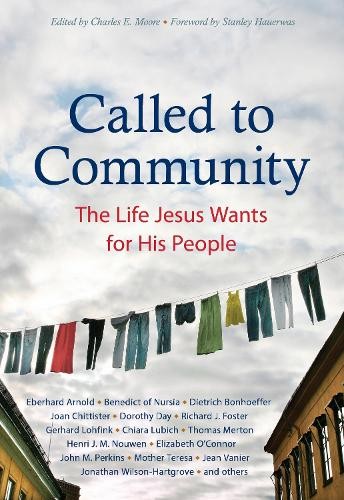
Titulo completo:
Called to Community. The life Jesus wants for his people.
Llamados a la comunidad. La vida que Jesús quiere para su pueblo.
Complied and edited by [Selección y edición por] Charles E. Moore
Foreword by Stanley Hauerwas
Plough Publishing House.
Walden New York, 2016. 359 pages
ISBN: 978-0-87486-743-5
Breve comentario:
Me sugirió la lectura del libro Heather Ruple, implicada en la reflexión y creación de comunidades intencionales en el Distrito lasaliano de Irlanda-Gran Bretaña-Malta. Le agradezco este acercamiento a la comunidad desde el pensamiento anglosajón. Nada más hay que echarle un vistazo al índice para descubrir la riqueza del enfoque de esta publicación. El libro está compuesto de 52 breves textos seleccionados para explicar cómo lo comunitario es una llamada actual a vivir el seguimiento de Jesús de Nazaret. Cada capítulo consta de entre 5 o 6 páginas con unas preguntas finales para el compartir (entre las citas que he seleccionado también he colocado un ejemplo de lo que se sugiere para este momento). Algunas de las experiencias que hay detrás de los textos se refieren a comunidades que viven bajo el mismo techo, pero sus reflexiones son igual de oportunas para nuestras comunidades lasalianas en el ARLEP. Reflejan realismo, humanidad e ilusión por construir comunidad. A pesar de mi limitado inglés, he conseguido seguir todos los capítulos, eso sí, con la ayuda del diccionario, no es un vocabulario difícil ni con frases complicadas. Echadle un vistazo a las citas seleccionadas, seguro que os inspirarán. Cada capítulo está pensado para animar una reunión comunitaria.
Para leer la traducción al castellano del índice y de las citas seleccionadas, clicar aquí
Brief description
Heather Ruple who is involved in the reflection and creation of intentional communities in the Lasallian District of Ireland-Great Britain-Malta suggested me to read this book. I thank her for this approach to the community from Anglo-Saxon thought. One only has to take a look at the index to discover the richness of the focus of this publication. The book is composed of 52 short texts selected to explain how the community is a current call to live the following of Jesus of Nazareth. Each chapter consists of between 5 or 6 pages with some final questions to share (among the quotes I have selected I have also placed an example of what is suggested for this moment). Some of the experiences behind the texts relate to communities living under the same roof, but their reflections are just as timely for our Lasallian communities in ARLEP. They reflect realism, humanity and enthusiasm for building community. Despite my limited English, I have managed to follow all the chapters with the help of the dictionary, it is not a difficult vocabulary or with complicated sentences. Take a look at the selected quotes, they are sure to inspire you. Each chapter is designed to facilitate a community meeting.
CONTENTS
Foreword [Prólogo] by Stanley Hauerwas
Introduction [Introducción] by Charles E. Moore
PART I – A Call to Community
1. The Great Idea – Fyodor Dostoyevsky
2. Blessed Community – Rufus Jones
3. Style of Life – Christoph Friedrich Blumhardt
4. Embodiment – Gerhard Lohfink
5. Brothers, Sisters – Hal Miller, Joseph H. Hellerman
6. Pentecost – C. Norman Kraus
7. Christian Communism – José P. Miranda, Helmut Gollwitzer
8. A Visible Reality – Dietrich Banhoeffer
9. Counterculture – Howard A. Snyder
10. The Way – Alden Bau
PART II – Forming Community
11. A Vision – George MacDonald
12. Life’s Task – Eberhard Arnold
13. It Takes Work – Charles E. Moore
14. Communion – Jean Vanier
15. Idealism – Dietrich Bonhoeffer
16. Illusions – Arthur Katz Elizabeth O’Connor Jean Vanier
17. Obstacles – Eberhard Arnold
18. Poisons – C. S. Lewis, Basilea Schlink
19. Beyond Self – Jean Vanier
20. Surrender – Arthur G. Gish
21. The Center – Dietrich Bonhoeffer, Friedrich Foerster
22. God’s Call – Henri J. M. Nouwen, Jean Vanier
23. Promises – Jonathan Wilson-Hartgrove
PART III – Life in Community
24. Love – Thomas Merton, Søren Kierkegaard
25. Deeds – Mother Teresa, Jean Vanier, John F. Alexander
26. Vocation – John F. Alexander
27. Acceptance – Jürgen Moltmann Adele J. Gonzalez
28. Irritations – Anthony de Mello, Roy Hession, Thomas à Kempis, Eberhard Arnold
29. Differences – Joan Chittister, Henri J. M. Nouwen
30. Conflict – David Janzen, Jean Vanier
31. Unity – Chiara Lubich, Stephen B. Clark
32. Dialogue – Elizabeth O’Connor, Jean Vanier
33. Leadership – Jean Vanier
34. Submission – Richard J. Foster, John F. Alexander
35. Money – Jodi Garbison, Jenny Duckworth
36. Children – Charles E. Moore
37. Family Values – Andy Crouch
38. Solitude – Henri J. M. Nouwen, Eberhard Arnold
39. Transparency – Roy Hession, Dietrich Bonhoeffer
40. Repentance – Benedict of Nursia, Johann Christoph Arnold, J. Heinrich Arnold
41. Forgiveness – Johann Christoph Arnold
42. At Table – Leonarde Beff, Dietrich Bonhoeffer
43. Celebration – Jean Vanier, Richard J. Foster
FART IV – Beyond the Community
44. Revolution – John M. Perkins
45. Comfort Zones – Eugene H. Peterson, Elton Trueblood
46. Good Fences – Elizabeth Dede, Jean Vanier
47. Next Door – Charles E. Moure
48. Interruptions – Emmanuel Katongole and Chris Rice
49. Hospitality – Christine D. Pahl
50. Welcome – Jean Vanier
51. Wounds – 313 Catherine de Hueck Doherty, Ed Loring
52. Mercy – Dorothy Day
Discussion Guide
Further Reading
Index of Authors
Sources and Acknowledgements
Quotes I’d like to highlight
“New intentional communities are emerging that bear witness to Christ’s healing power. A radical renaissance is unfolding among disenchanted Christians who are no longer satisfied with either Sunday religion or social activism. Today’s Christians want to be the church, to follow Christ together and demonstrate in their daily lives the radical, transforming love of God.” P. xvii
“The primary function of a church, if it is to be the continuing body of Christ in the world, is to raise human life out of its secular drift and to give reality to the eternal here in the midst of time.” P. 8
“For this reason I do not think much of «spiritual communities.» They do not last. People are friends for a while, but it eventually ends. Anything that is going to last must have a much deeper foundation than some kind of spiritual experience. Unless we have community in the flesh, in things material, we will never have it in spiritual matters (1 John 3:16-18). We are not mere spirits. We are human beings of flesh and blood. Every day we need to eat. We need clothing for every season. We must share our tools; we must work together; we must work communally and not each for himself. Otherwise we can never become one in the love of Christ, can never become the flock, the community of Jesus that stands up in the world and says, «Now things must become quite different. Now the individual must stop living for himself. Now a society of brothers and sisters must arise.» P. 16
“It would be essential that they weave together all their gifts and opportunities, that in their gatherings they judge their entire lives in light of the coming of the reign of God and allow themselves to be gifted with the unanimity of agape. Then the community would become the place where the messianic signs that are promised to the people of God could shine forth and become effective.” P. 18
“What is decisive, after all, what everything depends on, is that the community knows that God has called it to make the divine plan visible and to be a place of reconciliation in the world as the body of Christ.” P. 21
“Thinking about the church as family makes a person’s specific gifts less relevant. It doesn’t matter what your gifts are; the fact is we need someone to take out the garbage, and here you are. The same thing is true of relationships. In a family, it doesn’t matter what another person’s gifts are; we are loving them or putting up with them or nourishing them because we are part of the same family, not because they have a particular gift.” P. 24
“The church can never tolerate any limits set to the love and service of the brethren. For where the brother is, there is the body of Christ, and there is his church. And there we must also be.” P. 47
“True community will never be achieved if human relation-ships go on as they are. The community we seek is not based on human nature but on the eternal God. It is fed by divine strength and comes to true unity in God not by reason of our own strength, or even our collective strength, but through a power given from above. Without faith that we will be given this spirit of complete love and fellowship, the spirit of Jesus Christ, we cannot last long in community. In other words, if you do not seek for God with your whole heart, if you do not seek for love and unity, and if this is not the all-important question for you, then in the long run seeking community is pointless.” P. 81
Discussion Guide – 12. Life’s Task
– Why does Arnold say community has to be about more than human relationships?
– What needs to happen before one can truly experience «heart-felt community»?
– How would you describe most people’s thirst for community today? Indifferent? Vague longing? Parched?
Related Scripture: John 15:9-17; 1 John 1:1-4; 4:7-21
“In other words, if we are to connect (or reconnect) our lives with one another, it will demand much more of us than we normally give. It demands that we become a church community, not just occasionally go to church or have community with others.” P. 89
“We need to give each other honest feedback on how much we work and why. Only in this way will we get free of the chains of having to earn and spend. Then the «common life» gets real and we start to really depend on one another; then God’s justice breaks in.” P. 91
“To love someone is not first of all to do things for them, but to reveal to them their beauty and value, to say to them through our attitude: «You are beautiful. You are important. I trust you. You can trust yourself.» We all know well that we can do things for others and in the process crush them, making them feel that they are incapable of doing things by themselves. To love someone is to reveal to them their capacities for life, the light that is shining in them.” P. 93
“He who loves his dream of community more than the Christian community itself becomes a destroyer of the latter, even though his personal intentions may be ever so honest and earnest and sacrificial.” P. 99
“No real growth takes place without pain. Nothing is born into the consciousness without suffering.” P. 105
“These difficulties can lead people to run away from community, to cut themselves off from those whom they find unsettling, to become introverted and refuse to communicate, to accuse and condemn others; or it can lead them to work on themselves, to struggle against selfishness and their need to be at the center of everything so as to welcome, understand, and serve others better. When this happens, community life becomes a school of love and a source of healing.” P. 106
“This is the root of grace: the dismantling of our own power. Only to the degree that all our own power is dismantled will God be able to give the fruits of the Spirit and build up his kingdom through us, in us, and among us.” P. 111
“We all should have the mind of Jesus Christ, but we do not all have to have the mind of a school teacher, a carpenter, a bank director, a congressman, or whatever socioeconomic or political group. There is a great wisdom hidden in the old bell tower calling people with very different backgrounds away from their homes to form one body in Jesus Christ. It is precisely by transcending the many individual differences that we can become witnesses of God who allows his light to shine upon poor and rich, healthy and sick alike. But it is also in this encounter on the way to God that we become aware of our neighbor’s needs and begin to heal each other’s wounds.” P. 138
“COMMUNITY IS A PLACE OF PAIN, of the death of ego. In community we are sacrificing independence and the pseudo-security of being closed up. We can only live this pain if we are certain that for us being in community is our response to a call from God. If we do not have this certitude of faith then we won’t be able to stay in community. I see this very much in our own communities.” P. 139
“To make promises is to proclaim that a culture of mistrust has been interrupted by One whom we can trust. It is to live as a sign of God’s faithfulness, even as we struggle to grow into fidelity ourselves. We make promises because we’ve glimpsed a picture of hope and know that it points us toward the life we were made for…” P. 144
“We make promises not because we will always be able to keep them, but because we trust a God who is faithful enough to always help us get up again.” P. 148
“The truth I must love in my brother is God himself, living in him. I must seek the life of the Spirit of God breathing in him. And I can only discern and follow that mysterious life by the action of the same Holy Spirit living and acting in the depths of my own heart.” P. 152
“It is easy to love those who live far away. It is not always easy to love those who live right next to us. It is easier to offer a dish of rice to meet the hunger of a needy person than to comfort the loneliness and the anguish of someone in our own home who does not feel loved.
I want you to go and find the poor in your homes. Above all, your love has to start there. I want you to be the good news to those right around you. I want you to be concerned about your next-door neighbor. Do you know who your neighbor is?” P. 160
“If you are discouraged, it is a sign of pride, because it shows you trust in your own powers. Never bother about people’s opinions. Be humble and you will never be disturbed. The Lord has willed me here where I am. He will offer a solution. (…)
You may be exhausted with work, you may even kill yourself with work, but unless your work is interwoven with love, it is useless. To work without love is slavery.” P. 161
“The great danger of talk about gifts is that we all use our gifts as weapons, to enhance our power or importance.” P. 163
“Nonetheless, the main gift the Spirit has given each person is the ability to clean the toilet (a contemporary equivalent of washing feet). We are clear on that for others but often not for ourselves. So in the body of Christ, it has to be an incantation: for each of us, our task is to clean the toilet, wash the dishes-in short, be a good brother or sister. That’s our mission. Clean up after the party, and when the baby down the hall starts crying at night, go get her. Or take the person with disabilities to the movies, hang out with your sisters in the evening, study the Bible to the extent of your abilities, and pray for your housemates.
Wash their feet. And don’t worry much about using your other gifts. Is that so hard?” P.164
“So what is our work? First, our most important work is living in reconciliation with our sisters and brothers in a church, and lying awake at night trying to figure out how to help others do the same. Second, we should take whatever paid or unpaid employment will do most to help our brothers and sisters live in unity.” P. 169
«Accept one another, then, just as Christ accepted you» (Rom. 15:7). Only this attitude can give us a new orientation and break through our limitations so that we can spring over our narrow shadows. It opens us up for others as they really are so that we gain a longing for and an interest in them. As a result of this we become able actually to forget ourselves and to focus on the way Christ has accepted us. How have we been accepted in Christ?” P. 172
“What do we do with the members of the body of Christ who cause us pain? Do we try to heal them and make them comfortable? Do we give them some space so that they do not hurt so much? Or do we ignore, reject, and get rid of them? Do we punish them with our indifference or neglect? (…)
The measure of the quality of a Christian community is the way in which its weakest members are treated and its willing-ness to welcome everyone as an important part of the body of Christ.” P. 175
“Jesus meant by the mote in the other person’s eye. It is some fault which we fancy we can discern in him; it may be an act he has done against us, or some attitude he adopts towards us. But what did the Lord Jesus mean by the beam in our eye? I suggest that the beam in our eye is simply our unloving reaction to the other man’s mote. Without doubt there is a wrong in the other person. But our reaction to that wrong is wrong too! The mote in him has provoked in us resentment, or coldness, or criticism, or bitterness, or evil speaking, or ill will-all of them variants of the basic ill, unlove.” P. 179
“There is no doubt that we need each other desperately. There are blind spots in all our lives that we shall never see, unless we are prepared for another to be God’s channel to us.” P. 181
“Creativity, it is too often forgotten, comes out of differences. It is the ability to function outside the lines, beyond the dots, despite the boxes and the mental chains by which we have forever been constrained, that fits us to be the architects of the future. Instead, we want everyone to think alike when what we really need are people who are thinking newly – about theology, about God, about faith, about morality, about science, about life.” P. 186
“In community, the particular talents of the individual members become like the little stones that form a great mosaic. The fact that a little gold, blue, or red piece is part of a splendid mosaic makes it not less but more valuable because it contributes to an image much greater than itself.” P. 188
“Tensions bring people back to the reality of their helplessness, obliging them to spend more time in prayer and dialogue, working patiently to overcome the crisis and refind lost unity, and making them understand that the community is more than just a human reality, that it also needs the spirit of God if it is to live and deepen. (…)
Every tension, every crisis can become a source of new life if we approach it wisely, or it can bring death and division.” P. 195
“Community life implies a personal commitment which is made real in meetings between people. But we are very quick to flee from these meetings. They frighten us, just because they commit us. We flee into administration, law, rules, the search for «objective truth»; we flee into work and activity. We flee from meeting people; we would rather do things for them. But if we are to love, we have to meet.
Creating community is something different from just meeting one with another, as individuals. It is creating a body and a sense of belonging, a place of communion, and this means meetings!
We must not go to a meeting carrying within us the pain of another meeting or the frustration coming from a disturbing situation or event in the community. The art of good meetings is in the way people prepare inwardly for them. If members come with an inner space of silence, availability, and even excitement, then the meeting will be a living and nourishing one. If they arrive disgruntled and angry-«Oh, another meeting!» – then we can be sure that is not going to be a nourishing one! And bad meetings (like good ones) become contagious. If we expect them to be bad and a waste of time, then they will be just that! If leaders are responsible for the animation of a meeting, we are all responsible for the quality of it by the way we live it….
Participation in a meeting means something much deeper than simply knowing how to talk. It implies a certain death to imposing our ideas or defending or proving something about ourselves. That sort of approach does not get you far in community. To participate in a community meeting you must have the certitude that Jesus is present, that he is leading us together, and that each one has a gift to bring to the meeting.” P. 206
“At the same time, and perhaps for the same reasons, many people confuse authority and the power of efficiency, as if the first role of people with responsibility is to make decisions, command effectively, and so exercise power. But their role is first of all to be people to whom others can turn for help and advice, to provide security, to affirm, to support, to encourage, and to guide.” P. 209
“When we fail to find space and time for children, when we forget to consider the needs of families, we risk losing sight of how God reigns on earth. In God’s kingdom, the «least of these» are the greatest. Jesus’ warning about anyone who causes one of these little ones to stumble (Matt. 18:6-9) is a serious one. He goes on to say that the angels sent to protect children «always see the face of my Father in heaven.» That’s how much God cares about each child and whether they are truly welcomed and loved. A community must do everything in its power to protect and nurture an atmosphere in which children can grow in faith. Otherwise, God’s kingdom is thwarted.” P. 228
“In solitude we come to know our fellow human beings not as partners who can satisfy our deepest needs, but as brothers and sisters with whom we are called to give visibility to God’s all-embracing love. In solitude we discover that community is not a common ideology, but a response to a common call. In solitude we indeed realize that community is not made but given.” P. 235
“Without solitude we begin to cling to each other; we begin to worry about what we think and feel about each other; we quickly become suspicious of one another or irritated with each other; and we begin, often in unconscious ways, to scrutinize each other with a tiring hypersensitivity. Without solitude shallow conflicts easily grow deep and cause painful wounds.” P. 237
“But we do need silence, a time when we neither take nor give but rest close to the source of life.
If our community life is so bustling with activity that we have too little time for sleep and for this creative pause, then our spiritual life is in great danger. A soul requires quiet – God created it that way. Without quiet we feel exhausted and burned-out, and an unnecessary crisis follows. We are spiritu-ally unfruitful when we are deprived of the creative pause.” P. 239
“Each of us has been hurt at one time or another, and each of us has hurt others. Therefore, just as all of us must forgive, so all of us need to be forgiven. Without forgiveness, we will not find peace.” P. 255
“Before we can forgive a hurt, we must be able to name it. Once we have done this, however, we must forgive and let go. (…)
All of us have wronged (and have been wronged by) others at some point in our lives. Yet to dwell on human failings is to deny the power of love and forgiveness. The Spirit can move in our lives if we only open our hearts to it. Love is greater than hatred, faith is greater than doubt, and hope is greater than despair.” P. 258
“The fellowship of the table teaches Christians that here they still eat the perishable bread of the earthly pilgrimage. But if they share this bread with one another, they shall also one day receive the imperishable bread together in the Father’s house. «Blessed is he that shall eat bread in the kingdom of God».
(Luke 14:15).” P. 263
“The danger nowadays is that people no longer know how to celebrate and eat together. In some families, everybody eats at different times. They are all busy with their own projects and people they have to meet and they bolt their food down. In order to create unity, to live as a body, we need to know how to take time over meals, to eat well with good wine or beer. We need to know how to tell stories, our own stories, and to laugh and sing together.” P. 266
“If we are no longer here for all people, if we can no longer concern ourselves with the need and suffering of the whole world, community life has lost its right to exist. EBERHARD ARNOLD, God’s Revolution.” P. 272
“SOMETIMES the reason for coming together, the goal of the community, can stifle personal relationships; individuals no longer meet as persons, in heart-to-heart relationships, but meet only as members of the same group, motivated by the same goals. Some people, in fact, hide behind the goals and activities of a group precisely in order to avoid relationships. They see the value of others only as members of the group, sharing goals and ideals, and not as individuals in themselves.” P. 288
“The «worries» of daily life-getting food on the table, paying the bills, getting the shopping and laundry and cleaning done, caring for children, being needed and listened to-are carried together. If we cannot do this among am ourselves, then what do we have to bring to the broken world?” P. 294
“Can we truly welcome strangers as they are, if we have not welcomed the community as it is and the members as they are? If we are angry with the community and its members, we risk using strangers to compensate for our anguish. That is not welcome.” P. 310
La traducción al castellano ha sido gracias al Word.
ÍNDICE
Prólogo de Stanley Hauerwas xiii
Introducción de Charles E. Moore xv
PARTE I – Una llamada a la comunidad
1. La Gran Idea – Fiódor Dostoyevski
2. Comunidad Bendita – Rufus Jones
3. Estilo de vida – Christoph Friedrich Blumhardt
4. Encarnación – Gerhard Lohfink
5. Hermanos, hermanas – Hal Miller, Joseph H. Hellerman
6. Pentecostés – C. Norman Kraus
7. Comunismo cristiano – José P. Miranda, Helmut Gollwitzer
8. Una realidad visible – Dietrich Banhoeffer
9. Contracultura – Howard A. Snyder
10. El camino – Alden Bau
PARTE II – Creando comunidad
11. Una visión – George MacDonald
12. La tarea de la vida – Eberhard Arnold
13. Requiere trabajo – Charles E. Moore
14. Comunión – Jean Vanier
15. Idealismo – Dietrich Bonhoeffer
16. Ilusiones – Arthur Katz Elizabeth O’Connor Jean Vanier
17. Obstáculos – Eberhard Arnold
18. Venenos – C. S. Lewis, Basilea Schlink
19. Más allá del yo – Jean Vanier
20. Entrega – Arthur G. Gish
21. El Centro – Dietrich Bonhoeffer, Friedrich Foerster
22. El llamado de Dios – Henri J. M. Nouwen, Jean Vanier
23. Promesas – Jonathan Wilson-Hartgrove
PARTE III – Vida en comunidad
24. Amor – Thomas Merton, Søren Kierkegaard
25. Escrituras – Madre Teresa, Jean Vanier, John F. Alexander
26. Vocación – John F. Alexander
27. Aceptación – Jürgen Moltmann Adele J. Gonzalez
28. Molestias – Anthony de Mello, Roy Hession, Thomas à Kempis, Eberhard Arnold
29. Diferencias – Joan Chittister, Henri J. M. Nouwen
30. Conflicto – David Janzen, Jean Vanier
31. Unidad – Chiara Lubich, Stephen B. Clark
32. Diálogo – Elizabeth O’Connor, Jean Vanier
33. Liderazgo – Jean Vanier
34. Sometimiento – Richard J. Foster, John F. Alexander
35. Dinero – Jodi Garbison, Jenny Duckworth
36. Hijos – Charles E. Moore
37. Valores familiares – Andy Crouch
38. Soledad – Henri J. M. Nouwen, Eberhard Arnold
39. Transparencia – Roy Hession, Dietrich Bonhoeffer
40. Arrepentimiento – Benedicto de Nursia, Johann Christoph Arnold, J. Heinrich Arnold
41. Perdón – Johann Christoph Arnold
42. En la mesa – Leonarde Beff, Dietrich Bonhoeffer
43. Celebración – Jean Vanier, Richard J. Foster
PARTE IV – Más allá de la comunidad
44. Revolución – John M. Perkins
45. Zonas de confort – Eugene H. Peterson, Elton Trueblood
46. Buenas cercas – Elizabeth Dede, Jean Vanier
47. Vecino – Charles E. Moure
48. Interrupciones – Emmanuel Katongole y Chris Rice
49. Hospitalidad – Christine D. Pahl
50. Bienvenidos – Jean Vanier
51. Heridas – 313 Catherine de Hueck Doherty, Ed Loring
52. Misericordia – Día de Dorothy
Guía de discusión
Lecturas recomendadas
Índice de autores
Fuentes y agradecimientos
Citas que destaco:
«Están surgiendo nuevas comunidades intencionales que dan testimonio del poder sanador de Cristo. Se está desarrollando un renacimiento radical entre los cristianos desencantados que ya no se conforman ni con la religión dominical ni con el activismo social. Los cristianos de hoy quieren ser la iglesia, seguir a Cristo juntos y demostrar en su vida diaria el amor radical y transformador de Dios.» P. xvii
«La función principal de una iglesia, si quiere ser el cuerpo continuo de Cristo en el mundo, es sacar la vida humana de su deriva secular y dar realidad a lo eterno aquí en medio de esta época.» P. 8
«Por esta razón, no pienso mucho en las ‘comunidades espirituales’. No duran. La gente participa durante un tiempo, pero al final lo deja. Cualquier cosa que vaya a durar debe tener una base mucho más profunda que algún tipo de experiencia espiritual. A menos que tengamos comunidad en la carne, en las cosas materiales, nunca la tendremos en asuntos espirituales (1 Juan 3, 16-18). No somos simples espíritus. Somos seres humanos de carne y hueso. Cada día necesitamos comer. Necesitamos ropa para todas las estaciones. Debemos compartir nuestras herramientas; debemos trabajar juntos; debemos trabajar en comunidad y no cada uno por uno mismo. De lo contrario, nunca podremos volvernos uno en el amor de Cristo, nunca podremos convertirnos en el rebaño, la comunidad de Jesús que se pone de pie en el mundo y dice: «Ahora las cosas deben cambiarse de verdad. Ahora el individuo debe dejar de vivir para sí mismo. Ahora debe surgir una sociedad de hermanos y hermanas.» p. 16
«Sería esencial que entretejan todos sus dones y oportunidades, que en sus reuniones juzguen toda su vida a la luz de la venida del reinado de Dios y se permitan ser dotados con la unanimidad del ágape. Entonces la comunidad se convertiría en el lugar donde los signos mesiánicos prometidos al pueblo de Dios pudieran brillar y volverse efectivos.» P. 18
«Lo que es decisivo, al fin y al cabo, de lo que todo depende, es que la comunidad sabe que Dios la ha llamado para hacer visible el plan divino y para ser un lugar de reconciliación en el mundo como cuerpo de Cristo.» P. 21
«Pensar en la iglesia como familia hace que los dones específicos de una persona sean menos relevantes. No importa cuáles sean tus dones; la realidad es que necesitamos a alguien que saque la basura, y aquí estás. Lo mismo ocurre con las relaciones. En una familia, no importa cuáles sean los dones de otra persona; los amamos, los soportamos o los nutrimos porque formamos parte de la misma familia, no porque tengan un don particular.» P. 24
«La iglesia nunca puede tolerar ningún límite puesto al amor y servicio de los hermanos. Porque donde está el hermano, está el cuerpo de Cristo, y allí está su iglesia. Y ahí también debemos estar.» P. 47
«La verdadera comunidad nunca se logrará si las relaciones humanas continúan como están. La comunidad que buscamos no se basa en la naturaleza humana, sino en el Dios eterno. Se alimenta de la fuerza divina y alcanza verdadera unidad en Dios no por nuestra propia fuerza, ni siquiera por nuestra fuerza colectiva, sino por un poder dado desde arriba. Sin fe en que se nos dará este espíritu de amor y comunión completos, el espíritu de Jesucristo, no podemos durar mucho tiempo en comunidad. En otras palabras, si no buscas a Dios con todo tu corazón, si no buscas amor y unidad, y si esta no es la pregunta más importante para ti, entonces a largo plazo buscar comunidad es inútil.» P. 81
Guía de discusión – 12. La tarea de la vida
– ¿Por qué Arnold dice que la comunidad tiene que ser algo más que las relaciones humanas?
– ¿Qué debe pasar para que uno pueda experimentar verdaderamente una «comunidad sentida»?
– ¿Cómo describirías la sed de comunidad de la mayoría hoy en día? ¿Indiferente? ¿Anhelo vago? ¿Muerta de sed?
Escritura relacionada: Juan 15, 9-17; 1 Juan 1, 1-4; 4, 7-21al
«En otras palabras, si vamos a conectar (o reconectar) nuestras vidas entre nosotros, nos exigirá mucho más de lo que normalmente damos. Exige que nos convirtamos en una comunidad eclesial, no solo que vayamos ocasionalmente a la iglesia o tengamos comunidad con otros.» P. 89
«Tenemos que darnos retroalimentación honesta sobre cuánto trabajamos y por qué. Solo así nos liberaremos de las cadenas de tener que ganar y gastar. Entonces la ‘vida común’ se vuelve real y empezamos a depender realmente unos de otros; entonces la justicia de Dios irrumpe.» p. 91
«Amar a alguien no es ante todo hacer cosas por esa persona, sino revelarle su belleza y su valor, decirle a través de nuestra actitud: ‘Eres hermosa. Eres importante. Confío en ti. Puedes confiar en ti mismo’. Todos sabemos bien que podemos hacer cosas por los demás y, en el proceso, aplastarlos, haciéndoles sentir que son incapaces de hacerlo por sí mismos. Amar a alguien es revelarle sus capacidades para la vida, la luz que brilla en él.» P. 93
«Quien ama su sueño de comunidad más que la propia comunidad cristiana se convierte en destructor de esta última, aunque sus intenciones personales sean muy honestas, sinceras y sacrificadas.» P. 99
«No hay crecimiento real sin dolor. Nada nace en la conciencia sin sufrimiento.» P. 105
«Estas dificultades pueden llevar a las personas a huir de la comunidad, a aislarse de quienes les resultan inquietantes, a volverse introvertidas y negarse a comunicarse, a acusar y condenar a otros; o puede llevarles a trabajar en sí mismos, a luchar contra el egoísmo y la necesidad de estar en el centro de todo para acoger, entender y servir mejor a los demás. Cuando esto ocurre, la vida comunitaria se convierte en una escuela de amor y una fuente de sanación.» P. 106
«Esta es la raíz de la gracia: el desmantelamiento de nuestro propio poder. Solo en la medida en que todo nuestro poder sea desmantelado Dios podrá dar los frutos del Espíritu y edificar su reino a través de nosotros, en nosotros y entre nosotros.» P. 111
«Todos deberíamos tener la mente de Jesucristo, pero no todos tenemos que tener la mente de un profesor, un carpintero, un director de banco, un congresista o cualquier otro grupo socioeconómico o político. Hay una gran sabiduría oculta en el antiguo campanario que llama a personas con orígenes muy diferentes a alejarse de sus hogares para formar un solo cuerpo en Jesucristo. Es precisamente trascendiendo las muchas diferencias individuales que podemos convertirnos en testigos de Dios, que permite que su luz brille sobre pobres y ricos, sanos y enfermos por igual. Pero también es en este encuentro en el camino hacia Dios donde tomamos conciencia de las necesidades de nuestro prójimo y comenzamos a sanar las heridas de los demás.» P. 138
«LA COMUNIDAD ES UN LUGAR DE DOLOR, de la muerte del ego. En la comunidad estamos sacrificando independencia y la pseudo-seguridad de estar encerrados. Solo podemos vivir este dolor si estamos seguros de que para nosotros estar en comunidad es nuestra respuesta a un llamado de Dios. Si no tenemos esta certeza de fe, no podremos permanecer en comunidad. Veo esto muy claramente en nuestras propias comunidades.» P. 139
«Hacer promesas es proclamar que una cultura de desconfianza ha sido interrumpida por Alguien en quien podemos confiar. Es vivir como signo de la fidelidad de Dios, incluso mientras luchamos por crecer en la fidelidad nosotros mismos. Hacemos promesas porque hemos vislumbrado una imagen de esperanza y sabemos que nos apunta hacia la vida para la que fuimos creados…» P. 144
«Hacemos promesas no porque siempre podamos cumplirlas, sino porque confiamos en un Dios lo suficientemente fiel como para ayudarnos siempre a levantarnos.» P. 148
«La verdad que debo amar en mi hermano es Dios mismo, viviendo en él. Debo buscar la vida del Espíritu de Dios que respira en él. Y solo puedo discernir y seguir esa vida misteriosa por la acción del mismo Espíritu Santo que vive y actúa en lo más profundo de mi propio corazón.» P. 152
«Es fácil amar a quienes viven lejos. No siempre es fácil amar a quienes viven justo a nuestro lado. Es más fácil ofrecer un plato de arroz para satisfacer el hambre de una persona necesitada que consolar la soledad y la angustia de alguien en nuestro propio hogar que no se siente querido.
Quiero que vayáis a buscar a los pobres en vuestros hogares. Por encima de todo, tu amor tiene que empezar ahí. Quiero que seas la buena noticia para quienes están a tu alrededor. Quiero que te preocupes por tu vecino de al lado. ¿Conoces a quien es tu vecino?» p. 160
«Si te desanimas, es un signo de orgullo, porque demuestra confianza en tus propios poderes. Nunca te preocupes por la opinión de los demás. Sé humilde y nunca serás molestado. El Señor me ha querido aquí donde estoy. Ofrecerá una solución. (…)
Puede que estés agotado por el trabajo, incluso te mates con el trabajo, pero a menos que tu trabajo esté entrelazado con amor, es inútil. Trabajar sin amor es esclavitud.» P. 161
«El gran peligro de hablar de dones es que todos usamos nuestros dones como armas, para aumentar nuestro poder o importancia.» P. 163
«No obstante, el principal don que el Espíritu ha dado a cada persona es la capacidad de limpiar el inodoro (un equivalente contemporáneo a lavar pies). Lo tenemos claro para los demás, pero a menudo no para nosotros mismos. Así que en el cuerpo de Cristo, tiene que ser una especie de mantra: para cada uno de nosotros, nuestra tarea es limpiar el baño, lavar los platos, en resumen, ser un buen hermano o hermana. Esa es nuestra misión. Recoge después de la fiesta y, cuando el bebé del pasillo empiece a llorar por la noche, ve a buscarla. O lleva a la persona con discapacidad al cine, pasa tiempo con tus hermanas por la noche, estudia la Biblia en la medida de tus capacidades y reza por tus compañeros de piso.
Lávales los pies. Y no te preocupes demasiado por usar tus otros dones. ¿Es tan difícil?» P.164
«¿Cuál es nuestro trabajo? Primero, nuestro trabajo más importante es vivir en reconciliación con nuestras hermanas y hermanos en la iglesia, y quedarnos despiertos por la noche intentando averiguar cómo ayudar a otros a hacer lo mismo. Segundo, deberíamos tomar el empleo remunerado o no remunerado que más ayude a nuestros hermanos y hermanas a vivir en unidad.» P. 169
«Aceptaos unos a otros, así como Cristo os aceptó a vosotros» (Rom. 15:7). Solo esta actitud puede darnos una nueva orientación y romper nuestras limitaciones para que podamos saltar sobre nuestras sombras estrechas. Nos abre a los demás tal y como son realmente, para que desarrollemos un anhelo e interés por ellos. Como resultado, llegamos a ser capaces de olvidarnos realmente de nosotros mismos y de centrarnos en la forma en que Cristo nos ha aceptado. ¿Cómo hemos sido aceptados en Cristo?» p. 172
«¿Qué hacemos con los miembros del cuerpo de Cristo que nos causan dolor? ¿Intentamos curarlos y hacerlos cómodos? ¿Les damos algo de espacio para que no les duela tanto? ¿O los ignoramos, rechazamos y nos deshacemos de ellos? ¿Les castigamos con nuestra indiferencia o negligencia? (…)
La medida de la calidad de una comunidad cristiana es la forma en que se trata a sus miembros más débiles y su disposición a acoger a todos como una parte importante del cuerpo de Cristo.» P. 175
«Jesús se refería a la mota en el ojo del otro. Es algún defecto que creemos poder discernir en él; puede ser una acción que ha hecho contra nosotros, o alguna actitud que adopte hacia nosotros. Pero, ¿qué quiso decir el Señor Jesús con la viga en nuestro ojo? Sugiero que la viga en nuestro ojo es simplemente nuestra reacción sin amor a la mota del otro. Sin duda, hay un error en la otra persona. ¡Pero nuestra reacción ante ese error también es errónea! La mota en él ha provocado en nosotros resentimiento, frialdad, crítica, amargura, mala palabra o mala voluntad, todas ellas variantes del mal fundamental, el desamor.» P. 179
«No hay duda de que nos necesitamos desesperadamente. Hay puntos ciegos en todas nuestras vidas que nunca veremos, a menos que estemos preparados para que otro sea el canal de Dios hacia nosotros.» P. 181
«La creatividad, que con demasiada frecuencia se olvida, surge de las diferencias. Es la capacidad de funcionar fuera de las líneas, más allá de los puntos, a pesar de las cajas y las cadenas mentales por las que siempre hemos estado limitados, lo que nos hace ser los arquitectos del futuro. En cambio, queremos que todos piensen igual cuando lo que realmente necesitamos son personas que piensen en novedad: sobre teología, sobre Dios, sobre la fe, sobre la moralidad, sobre la ciencia, sobre la vida.» P. 186
«En comunidad, los talentos particulares de los miembros individuales se convierten en las pequeñas piedras que forman un gran mosaico. El hecho de que una pequeña pieza dorada, azul o roja forme parte de un espléndido mosaico la hace no menos, sino más valiosa porque contribuye a una imagen mucho mayor que ella misma.» P. 188
«Las tensiones devolven a las personas a la realidad de su impotencia, obligándoles a pasar más tiempo en oración y diálogo, trabajando pacientemente para superar la crisis y recuperar la unidad perdida, y haciéndoles entender que la comunidad es más que una simple realidad humana, que también necesita el espíritu de Dios si quiere vivir y profundizar. (…)
Cada tensión, cada crisis puede convertirse en una fuente de nueva vida si la abordamos con sabiduría, o puede traer muerte y división.» P. 195
«La vida comunitaria implica un compromiso personal que se hace real en las reuniones entre personas. Pero somos muy rápidos en huir de las reuniones. Nos asustan solo porque nos comprometen. Huimos hacia lo administrativo, la norma, las reglas, la búsqueda de la ‘verdad objetiva’; huimos hacia el trabajo y la actividad. Huimos de conocer gente; preferimos hacer cosas por ellos. Pero si queremos amar, tenemos que encontrarnos.
Crear comunidad es algo diferente a simplemente encontrarse como individuos. Es crear un cuerpo y un sentido de pertenencia, un lugar de comunión, ¡y eso significa reuniones!
No debemos acudir a una reunión llevando dentro el dolor de otra reunión o la frustración que surge de una situación o evento perturbador en la comunidad. El arte de las buenas reuniones está en la forma en que la gente se prepara internamente para ellas. Si los miembros llegan con un espacio interior de silencio, disponibilidad e incluso emoción, entonces la reunión será viva y nutritiva. Si llegan molestos y enfadados—»¡Oh, otra reunión!», ¡entonces podemos estar seguros de que no será una reunión nutritiva! Y las malas reuniones (como las buenas) se vuelven contagiosas. Si esperamos que sean malos y una pérdida de tiempo, ¡entonces serán precisamente eso! Si los líderes son responsables de la animación de una reunión, todos somos responsables de su calidad por la manera en que la vivimos…
Participar en una reunión significa algo mucho más profundo que simplemente saber hablar. Implica una muerte segura a imponer nuestras ideas o defender o demostrar algo sobre nosotros mismos. Ese tipo de enfoque no te lleva lejos en la comunidad. Para participar en una reunión comunitaria debes tener la certeza de que Jesús está presente, de que nos guía juntos y de que cada uno tiene un don que llevar a la reunión.» P. 206
«Al mismo tiempo, y quizás por las mismas razones, muchas personas confunden autoridad y eficacia, como si el primer papel de las personas con responsabilidad fuera tomar decisiones, ordenar eficazmente y así ejercer el poder. Pero su papel es, ante todo, ser personas a las que otros puedan acudir en busca de ayuda y consejo, proporcionar seguridad, afirmar, apoyar, animar y guiar.» P. 209
«Cuando no encontramos espacio y tiempo para los niños, cuando olvidamos considerar las necesidades de las familias, corremos el riesgo de perder de vista cómo Dios reina en la tierra. En el reino de Dios, los ‘más pequeños de estos’ son los más grandes. La advertencia de Jesús sobre cualquiera que haga tropezar a uno de estos pequeños (Mat. 18,6-9) es seria. Continúa diciendo que los ángeles enviados para proteger a los niños ‘siempre ven el rostro de mi Padre que está en los cielos’. Así de bien se preocupa Dios por cada niño y por si realmente son bienvenidos y amados. Una comunidad debe hacer todo lo posible para proteger y fomentar un ambiente en el que los niños puedan crecer en la fe. De lo contrario, el reino de Dios es frustrado.» P. 228
«En la soledad llegamos a conocer a nuestros semejantes no como compañeros que pueden satisfacer nuestras necesidades más profundas, sino como hermanos y hermanas con quienes estamos llamados a dar visibilidad al amor todo-abarcador de Dios. En la soledad descubrimos que la comunidad no es una ideología común, sino una respuesta a una llamada común. En la soledad nos damos cuenta de que la comunidad no se hace sino se da.» P. 235
«Sin soledad empezamos a aferrarnos el uno al otro; empezamos a preocuparnos por lo que pensamos y sentimos los unos por los otros; rápidamente nos volvemos sospechosos o irritados el uno con el otro; y empezamos, a menudo de forma inconsciente, a examinarnos unos a otros con una hipersensibilidad cansada. Sin soledad, los conflictos superficiales se profundizan fácilmente y causan heridas dolorosas.» P. 237
«Pero necesitamos silencio, un tiempo en el que no tomamos ni damos, sino que descansamos cerca de la fuente de la vida.
Si nuestra vida comunitaria está tan llena de actividad que tenemos muy poco tiempo para dormir y para esta pausa creativa, entonces nuestra vida espiritual corre un gran peligro. Un alma necesita silencio: Dios la creó así. Sin silencio nos sentimos exhaustos y quemados, y sigue una crisis innecesaria. Somos espiritualmente infructuosos cuando nos privan de la pausa creativa.» P. 239
«Cada uno de nosotros ha sido herido en algún momento, y cada uno ha herido a otros. Por lo tanto, así como todos debemos perdonar, todos necesitamos ser perdonados. Sin perdón, no encontraremos paz.» P. 255
«Antes de poder perdonar un dolor, debemos ser capaces de ponerle nombre. Sin embargo, una vez hecho esto, debemos perdonar y dejar ir. (…)
Todos hemos hecho daño a otros en algún momento de nuestra vida (y hemos sido perjudicados por otros). Sin embargo, quedarse en los fallos humanos es negar el poder del amor y el perdón. El Espíritu puede moverse en nuestras vidas solo si abrimos nuestro corazón a él. El amor es más grande que el odio, la fe es más grande que la duda y la esperanza es mayor que la desesperación.» P. 258
«La comunión de la mesa enseña a los cristianos que aquí aún se come el pan perecedero de la peregrinación terrenal. Pero si comparten este pan entre ellos, también recibirán algún día el pan imperecedero juntos en la casa del Padre. ‘Bienaventurado el que comerá pan en el reino de Dios’ (Lucas 14, 15).» P. 263
«El peligro hoy en día es que la gente ya no sabe cómo celebrar y comer juntos. En algunas familias, cada uno come en diferentes momentos. Todos están ocupados con sus propios proyectos y con las personas con las que tienen que encontrarse, y comen a toda prisa. Para crear unidad, para vivir como un cuerpo, necesitamos saber dedicar tiempo a las comidas, comer bien con buen vino o cerveza. Necesitamos saber contar historias, nuestras propias historias, y reír y cantar juntos.» P. 266
«Si ya no estamos aquí para todas las personas, si ya no podemos preocuparnos por la necesidad y el sufrimiento de todo el mundo, la vida comunitaria ha perdido su derecho a existir. Eberhard Arnold, La revolución de Dios.» p. 272
«A VECES la razón de unirse, el objetivo de la comunidad, puede sofocar las relaciones personales; las personas ya no se encuentran como personas, en relaciones sinceras, sino que solo se encuentran como miembros del mismo grupo, motivados por los mismos objetivos. De hecho, algunas personas se esconden tras los objetivos y actividades de un grupo precisamente para evitar relaciones. Ven el valor de los demás solo como miembros del grupo, compartiendo metas e ideales, y no como individuos en sí mismos.» P. 288
«Las ‘preocupaciones’ de la vida diaria—poner comida en la mesa, pagar las facturas, hacer la compra, la colada y la limpieza, cuidar de los niños, sentirse necesitado y escuchado van juntos. Si no podemos hacer esto entre nosotros mismos, ¿qué tenemos que aportar a un mundo roto?» P. 294
«¿Podemos realmente dar la bienvenida a los desconocidos tal y como son, si no hemos acogido a la comunidad tal como es y a los miembros tal como son? Si estamos enfadados con la comunidad y sus miembros, corremos el riesgo de usar desconocidos para compensar nuestra angustia. Eso no es acoger.» P. 310
Imagen destacada: pexels-merve-bayar-158520570-10863555 (modificada)